



Regina Pacis Church


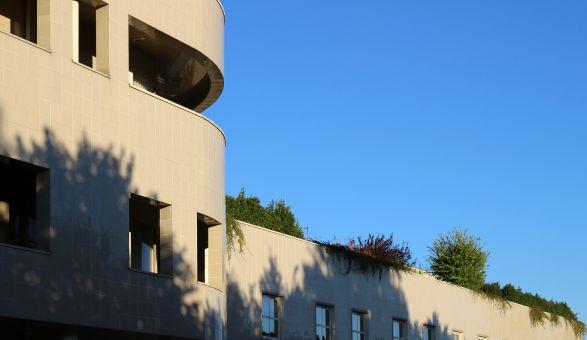
The church is a solid elliptical volume resting on a robust reinforced concrete floor that follows the curved shape of the nave and connects the parvis with the intermediate floor of the parish facilities.
The project is situated in the Velletri area, in the province of Rome, on the side of the hill that rises up in the north to the southern fringes of the Castelli Romani Regional Park and to Monte Artemisio. Part of a large zone that has been built on since the post-war period, the area is characterised by small and medium constructions isolated within land used for agricultural and residential purposes.
Located within a territory that was once home to the Castra Albana fortress and the Roman Ville d’Otium (including the residences of Domitian in Castel Gandolfo and those of Cicero in Tusculum), the area the work was carried out in contains a wealth of raw material resources for the creation of a project firmly rooted in and consistent with the surroundings. Immediately following the fall of the Western Roman Empire, the area was marked by the phenomenon of encastellation, whereby numerous noble families and high-ranking members of the clergy settled there, building fortified residences on the high ground, around which populous neighbourhoods gradually formed. The centuries that followed witnessed a succession of violent episodes, with Barbarian invasions and internal power struggles. It was not until the mid-16th century that peace arrived, and with it prosperity. During this period, rich landowners endeavoured to enrich and embellish the infrastructures of their vast properties.
The project proposed by the architects Ada Toni, Andrea Cavicchioli and Cristiano Cossu reconnects with this historical period that had the greatest impact on the area. By reinventing shapes and volumes inspired by military architecture, the project sought to design spaces destined for community life, set in a light, airy garden for the whole town to enjoy.
The primary aim of the project was to shape both volumes and functions in such a way as to create a compound system, with a simple, clear pattern. The architectural complex is not conceived as a foreign object; it is nourished by the very essence of the place, by its materials and colours. The arrangement of the volumes is determined by the privileged views that emerge from the mists of history as a sort of apparition, bringing the past back to life.
The architectural system is shaped with the specific purpose of enhancing the lay of the land and defining places with the ability to become actual belvederes in various positions, accessible to the public.
In an elevated position with respect to the buildings that make up the parish centre, the enveloping outline of the construction echoes across the setting, with its intense presence and rigorous geometries governing the environs in the same way as the churches in the surrounding area.
The value of the two main typological and symbolic concepts underlying the project (the tower with a circular base, characteristic of the small forts of centuries past, and the crown, traditionally a defining feature of the iconography of Our Lady of Peace, to which the place of worship is consecrated) is enhanced by the choice of finishing materials, inspired by the weight, strength and colour of the local stone and bricks, focusing primarily on the delicate grey-beige tones of peperino tuff.
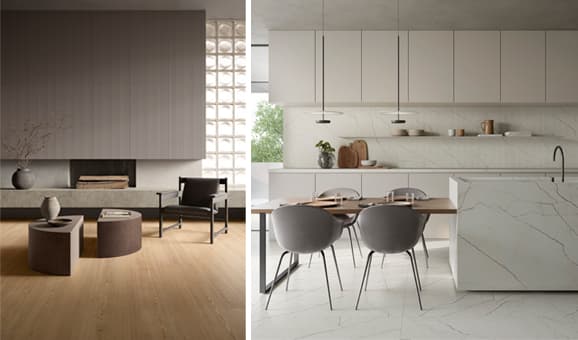
The façades are clad using porcelain stoneware tiles from the Pietre Etrusche collection, in the colour Saturnia and in the formats 30x120 cm and 60x120 cm.